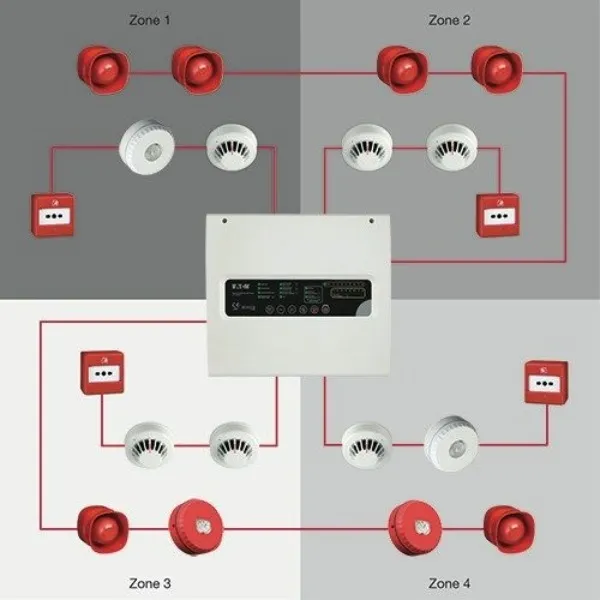
A Zone-Based Fire Detection System (also known as a conventional fire alarm system) is designed to provide reliable fire detection by dividing a protected premises into multiple electrical zones, each consisting of a group of initiating devices such as smoke detectors, heat detectors, and manual call points wired in parallel circuits. Each zone is connected to a central control panel that continuously monitors circuit integrity for alarm and fault conditions. When a device within a specific zone is activated, the control panel identifies the corresponding zone and initiates audible and visual alarm signals, enabling occupants to take prompt evacuation measures while indicating the general location of the fire. The system typically incorporates end-of-line resistors for supervision, ensuring detection of open or short circuit faults, and may interface with ancillary equipment such as hooters, strobes, and fire suppression systems. Although it does not provide pinpoint identification of the exact device, its simple architecture, cost-effectiveness, and ease of installation make it suitable for small to medium-sized facilities where general area identification is sufficient.
Keywords