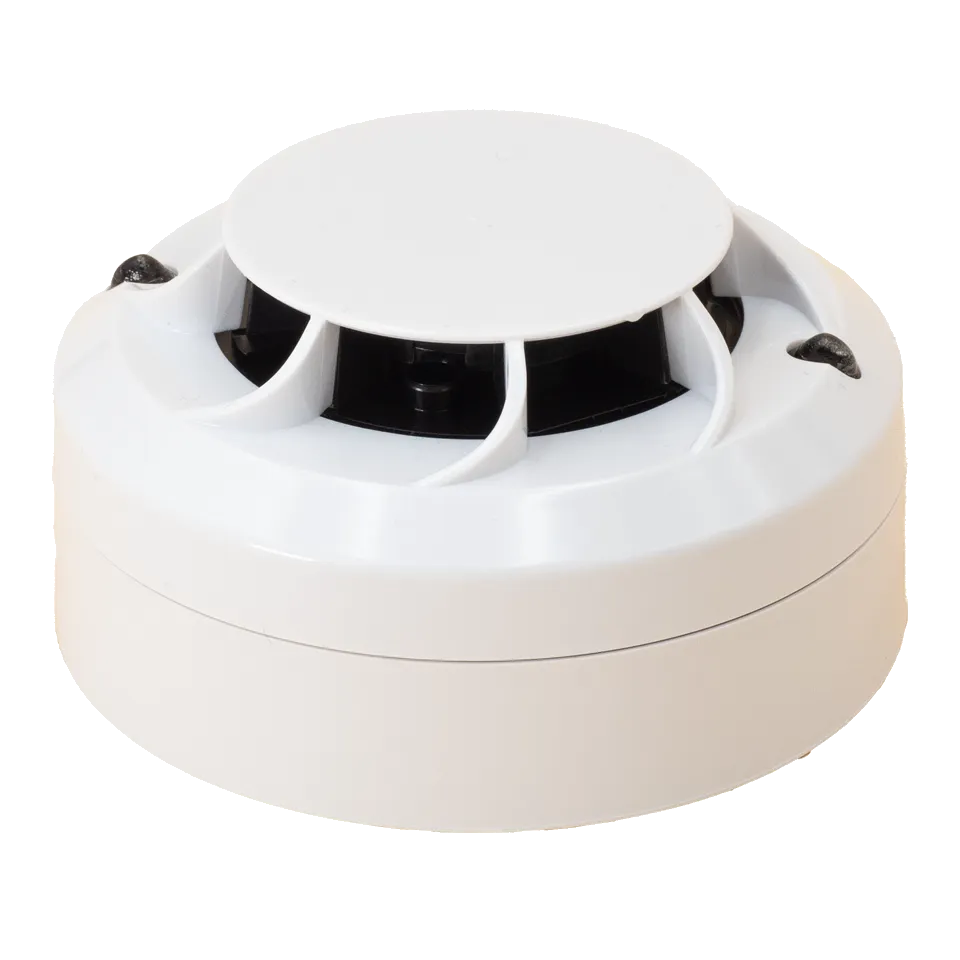
An 'addressable smoke detector' is an intelligent fire detection device used in modern fire alarm systems where each detector has a 'unique digital address', allowing the control panel to identify the exact location of a fire or fault. It typically works on the 'photoelectric (optical) sensing principle', where an internal light source and sensor are arranged so that, under normal conditions, light does not reach the sensor. When smoke particles enter the sensing chamber, they scatter the light beam onto the sensor, triggering a signal. This signal is processed by an internal microprocessor and transmitted to the fire alarm control panel through a communication loop. The panel continuously polls each detector, monitoring its status in real time. When smoke concentration exceeds a preset threshold, the detector sends an alarm along with its address, enabling precise identification of the affected area. Addressable detectors also feature 'self-diagnostics, sensitivity adjustment, and reduced false alarms', making them more reliable and suitable for commercial and industrial fire safety systems.
Keywords