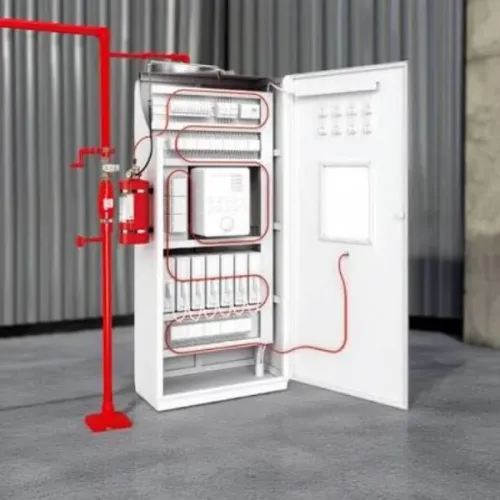
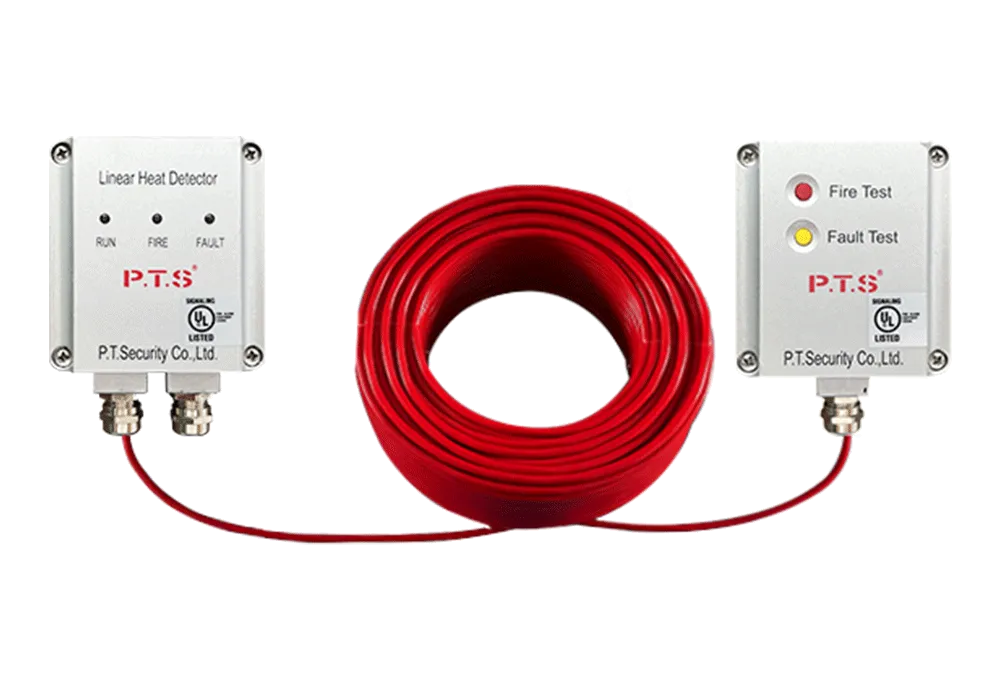
A 'heat detection cable', commonly known as a 'Linear Heat Detection (LHD) cable', is a continuous fire detection device designed to sense temperature changes along its entire length. It consists of two conductive wires separated by a heat-sensitive insulating material and protected by an outer jacket. Under normal conditions, the insulation prevents electrical contact between the conductors, keeping the circuit in a stable state. When the surrounding temperature rises to a predetermined threshold, the insulation either melts (in digital type cables) or changes its electrical resistance (in analog type cables). In digital systems, the melting insulation causes the conductors to touch, creating a short circuit that is detected by the fire alarm control panel, which then triggers an alarm. In analog systems, the gradual change in resistance is continuously monitored, and when it exceeds a set limit, an alarm is activated. This type of cable provides continuous, real-time temperature monitoring and is widely used in environments such as tunnels, cable trays, industrial plants, and storage facilities where point-type detectors may not be effective.
Keywords